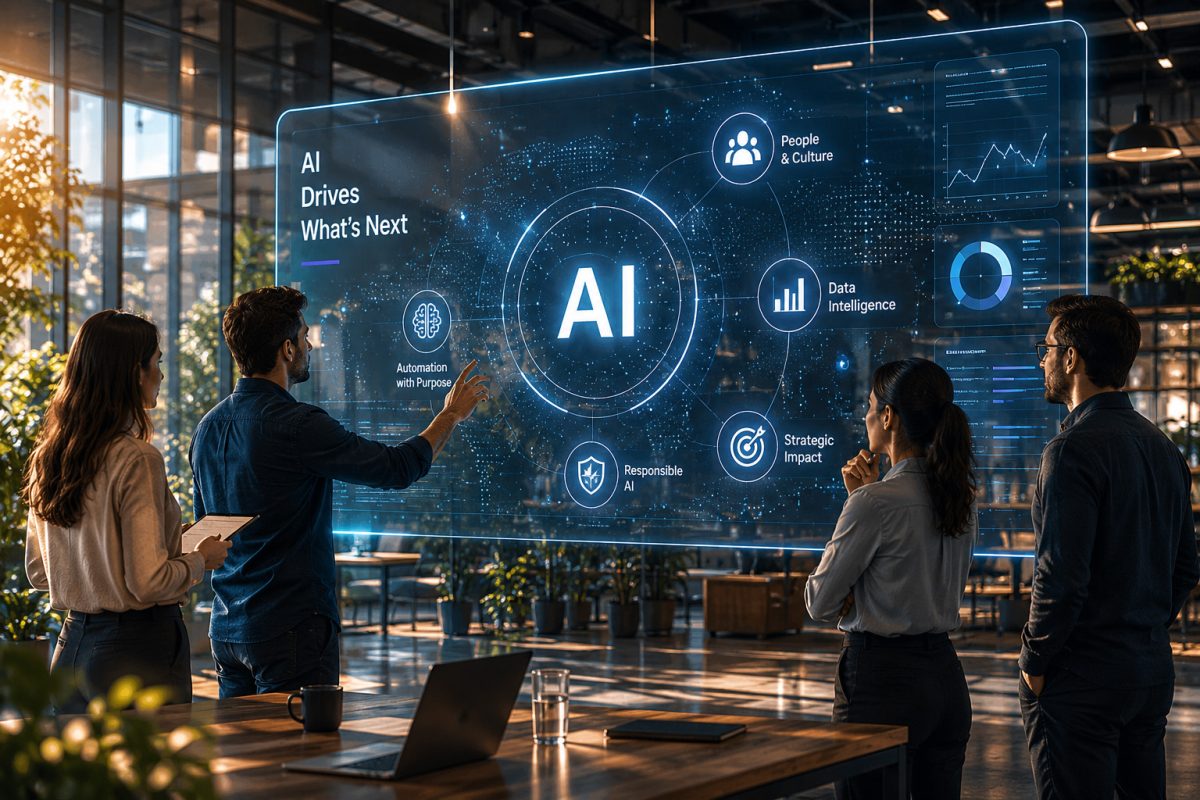
However, the reality is that many organizations fail in their AI initiatives—not due to technical shortcomings, but because of low adoption, lack of trust, or misalignment between the objectivesthese tools aim to achieve and the perspective of the people within the organization. Effectively integrating AI into the production process is not just about implementing code or using specific platforms;it is about embedding this technology into the organization’s DNA in a secure and sustainable way, ensuring its use is truly valuable.
The heart of the strategy: people
This requires a comprehensive approach that combines organizational change management driven by AI with technical implementation. The goal is to ensure that AI initiatives are deployed effectively, which means they must be understood, accepted, and actively used by those who need them.
This approach is based on the premise that AI should enhance human work, not replace it. That is why it is essential to begin with a deep organizational assessment that takes into account the company’s culture, digital maturity, and readiness for change. This allows organizations to identify adoption barriers as well as opportunities for implementation.
There is a clear path to ensuring that AI integration within a company is smooth and generates immediate value. First, it requires a cultural transformation and strong internal leadership. AI cannot be adopted from an analog mindset. Instead, organizations must evolve toward a culture that embraces AI-driven innovation, where leaders are trained to manage hybrid teams (humans and machines) and make data-driven decisions.
The success of this process also depends on creating an environment of learning, challenge, and experimentation—one where it is possible to test and iterate without the pressure of delivering a perfect solution from day one. This is partly because the possibilities of this technology evolve month by month, and also because its progress is increasingly rapid, dynamic, and disruptive. We are navigating largely uncharted territory, where certainty is limited.
Additionally, it is essential to optimize processes with a human impact in mind. When identifying inefficiencies that AI can solve, organizations must incorporate the human factor by developing plans to reassign employees whose tasks become automated to higher-value activities, such as creativity and decision-making. This approach leverages their expertise and reduces the negative perception that can arise when tools make certain roles redundant.
At Baufest, we understand that the entire process must place people at the center. It is not enough to provide a tool; organizations must be supported in the reinvention of roles, ensuring that jobs are redesigned to focus on inherently human skills such as empathy and strategic judgment.
A successful AI strategy requires a narrative that demystifies the technology and reduces internal fears. By integrating innovative solutions with strong change management, companies not only achieve a technological transition, but also unlock the potential for sustainable growth where AI acts as an ally that enhances what already exists, rather than as a force that disrupts systems that were previously functioning effectively.