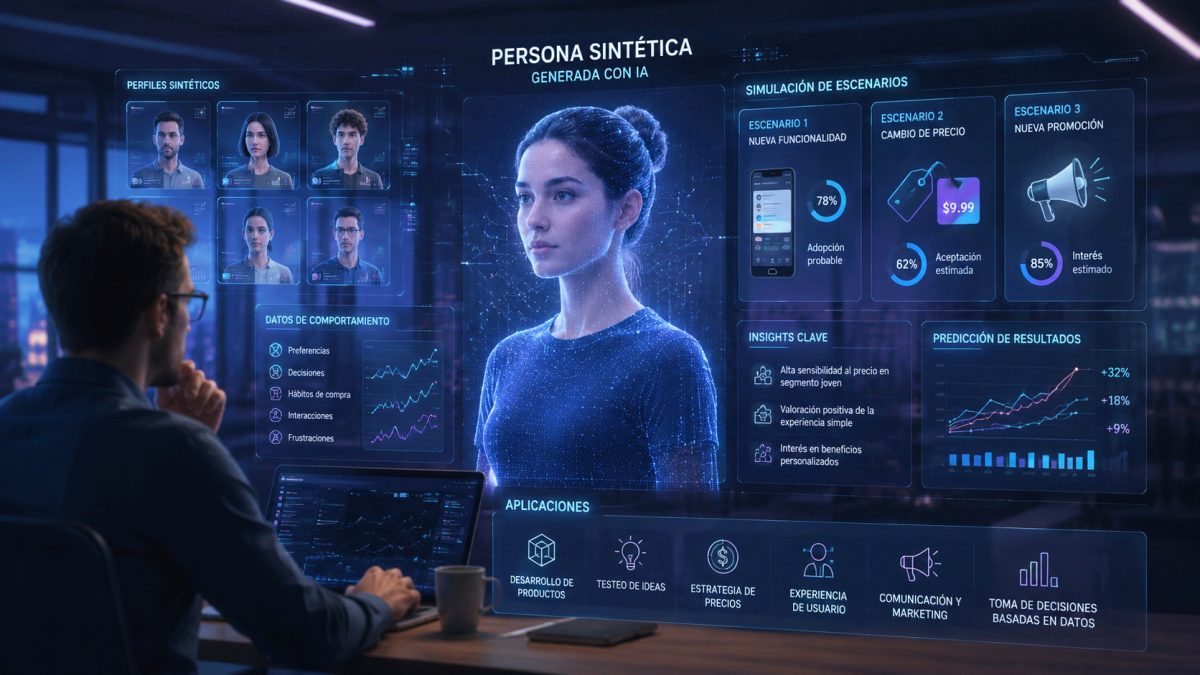
Thinking differently—and being able to challenge that idea against reality—is key. One of the most disruptive tools to emerge in this space is synthetic people: AI-generated user archetypes trained on massive datasets to build a realistic behavioral foundation, capable of simulating decisions, choices, and even human frustrations.
What makes them so appealing? Synthetic people allow companies to test ideas across multiple hypothetical scenarios almost instantly and at a very low cost. Their main application lies in stress-testing new proposals across dozens of theoretical contexts before they reach the real market. In the past, experts relied on their domain knowledge, intuition, and common sense to estimate how a market or audience might react to a new product. Today, that situation can be simulated, with multiple variables adjusted, knowing that the reactions of synthetic people are grounded in realistic human behavior.
This is especially useful for simulating hard-to-reach user segments or those that do not yet exist in a given market, as well as for identifying patterns and behaviors across large audiences with high precision. It also helps reduce time-to-insight—that is, the duration of the early stages of product design.
A well-known example is that of a telecommunications company that used synthetic customers to explore new products by testing features, pricing, and promotions to determine the optimal go-to-market strategy. Another case is that of an insurance company that used synthetic users and rapid prototyping to test a new product expected to generate $1 billion in revenue over five years—starting from a low-cost testing environment—because synthetic people enable exploration of a wide range of possibilities quickly, easily, and cost-effectively.
The main appeal of this technology lies in its ability to act as a catalyst that accelerates the pace of business operations. Leading companies that have already integrated AI into their innovation processes have found that their new product timelines can accelerate by 20% or more. By simulating user experiences at scale, organizations can make more informed decisions in a fraction of the time required by traditional methods.
Limits and risks of synthetic users
Despite their power, synthetic people have clear limitations that every innovation leader must recognize: they do not replace real users. Their operation is based on probabilistic models, which means they may miss nuances, deep emotions, or edge cases that only humans experience.
Additionally, there is a risk that these digital personas may reflect biases present in their training data, potentially amplifying inaccuracies faster than traditional research methods. Over-reliance on these models can lead to products that have not been validated with the empathy and deep understanding that only real human interaction can provide.
Thus, if there is one key takeaway from the emergence of tools like synthetic people, it is that they should be seen as a “capability multiplier”, never as a substitute for human interaction. AI is an exceptional tool for accelerating tedious research processes, allowing teams to hear the voice of the customer more clearly—but it does not perform magic.
Ultimately, the future of innovation will not be driven by AI alone, but by those who know when to let the machine guide the process and when to take the wheel. AI accelerates the work, but strategic, ethical, and creative decisions must continue to rely on people.