Ever since computer systems have existed, there has also been a fundamental question: how can we enable people to interact as effectively as possible with the information and functionality available within those systems? The command line, graphical interfaces, clicks and taps, multimodal systems—all of these foundational developments in digital design are undergoing a structural transformation driven by generative artificial intelligence, which is now becoming embedded across virtually every system.
We are leaving behind an era in which screens and keyboards were the primary means of interaction and entering a world of living systems that interpret context, intent, and behavior. These systems are capable of understanding our commands across multiple platforms while also extending beyond their own environments to interact with remote systems.
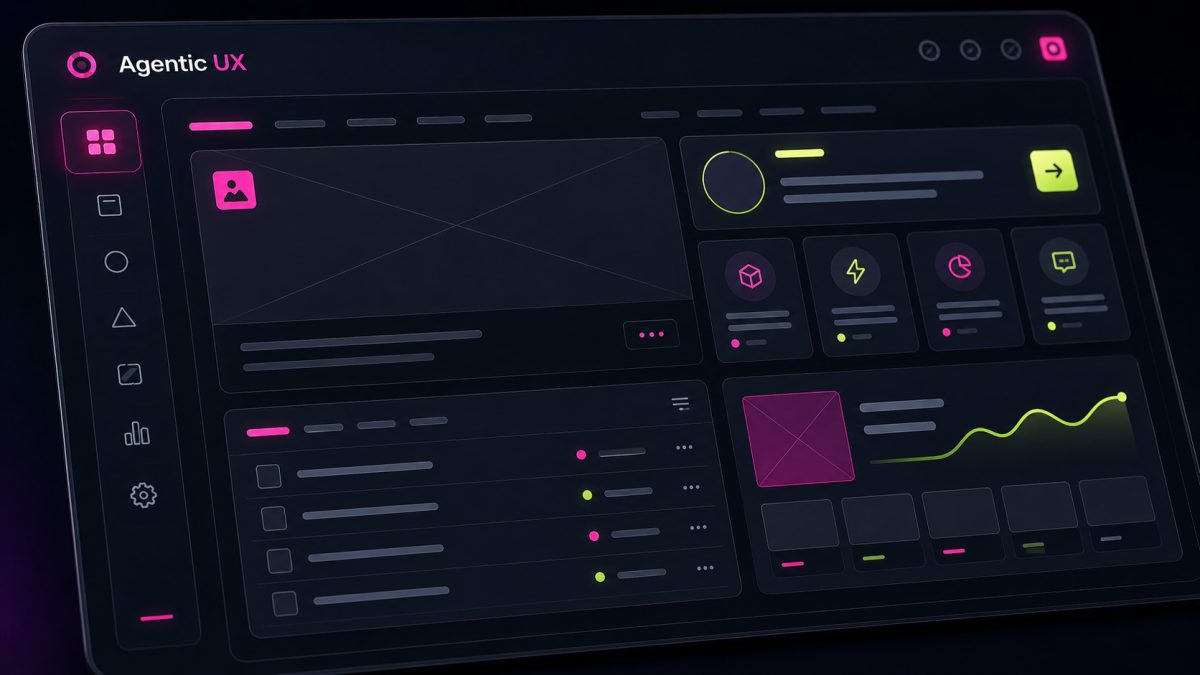
The rise of AI has given way to Agentic UX, a paradigm in which autonomous agents adapt experiences in real time, personalizing interfaces and addressing needs instantly.
Interactions are no longer simply between a person and an application. They also take place through assistants, chatbots, or AI agents that retrieve information, execute actions, or interact with different internal and external systems. This means designers are no longer designing solely for people. Today, applications, content, and architectures must also be prepared so that AI can understand, use, and interact with them naturally and transparently, both within and beyond the organization.
As a result, a product must be empathetic enough to connect with human emotions—for example, through “emotional design” that uses AI to adjust colors or typography according to a user’s mood—while also having a data structure robust and standardized enough for an AI agent to perform complex actions without friction. And this structure must work both ways: systems must be designed to interact with others on our behalf while also responding appropriately and promptly to requests from third parties.
The new role of the Product Designer: from executor to strategist
The role of the digital product designer is shifting from thinking about the position and value of every pixel on the screen toward design strategy and systems orchestration. With AI tools capable of autonomously generating components, auto layouts, and even complete interfaces, the focus is now moving toward identifying problems and defining behavioral “patterns” rather than isolated atomic elements: anticipating what users might need in each situation and determining the most direct way to address those needs.
In this new scenario, prompt design is becoming a form of programming: a small adjustment to the instructions can dramatically change a product’s output and behavior. As a result, the designer is evolving into a curator and strategist who guides AI toward solutions that are both functional and flexible.
Designing for both humans and AI is profoundly transforming application architecture, giving rise to new concepts:
- Adaptive interfaces: the UI is no longer fixed and identical for everyone; it changes and learns based on the user’s history and detected goals.
- Zero UI: experiences are moving toward “invisible” interactions based on natural language or gestures, reducing visual load.
- Information organization: content must be optimized both for search engines (SEO) and AI engines (GEO), making it easier for assistants to accurately extract, interpret, and process information.
- Predictive design: user flows become dynamic, anticipating the user’s next action based on massive data patterns analyzed in real time.
Embracing this transition in design and incorporating it into a company’s production processes is not an aesthetic matter; it is a strategic competitive advantage. Organizations that effectively integrate AI into their design workflows can increase productivity and reduce operating costs. In addition, a company’s ability to adopt these technologies has become a key indicator of its capacity for innovation.
Companies that begin designing today with interoperability between humans and AI agents in mind will not only deliver more personalized and scalable experiences, but will also build more robust and flexible products capable of successfully adapting to the technological changes of the years ahead.